
Do You Need Paint Correction Before Ceramic Coating?
Find out why paint correction before ceramic coating is essential for the best results and what happens if you skip this critical step.

Co-founder of Gemstar Eagle with 15+ years in professional auto detailing.
We regularly hear the same important question from new clients: Do You Need Paint Correction Before Ceramic Coating?
The reality is that factory handling and lot washing almost always leave microscopic scratches behind.
Our professional auto detailing team at Gemstar Eagle considers this preparation the absolute foundation of a successful finish.
Let’s look at the data, what it actually means for your clear coat, and how to assess your own vehicle’s condition.
What Is Paint Correction?
Paint correction is the process of removing surface imperfections from your vehicle’s clear coat using specialized machine polishers and compounds. The average modern clear coat is only 35 to 50 microns thick, which is roughly half the thickness of a sheet of copy paper. Our technicians carefully level this surface to eliminate daily wear and tear.
A professional correction typically removes just 1 to 3 microns of material to fix the following common issues:
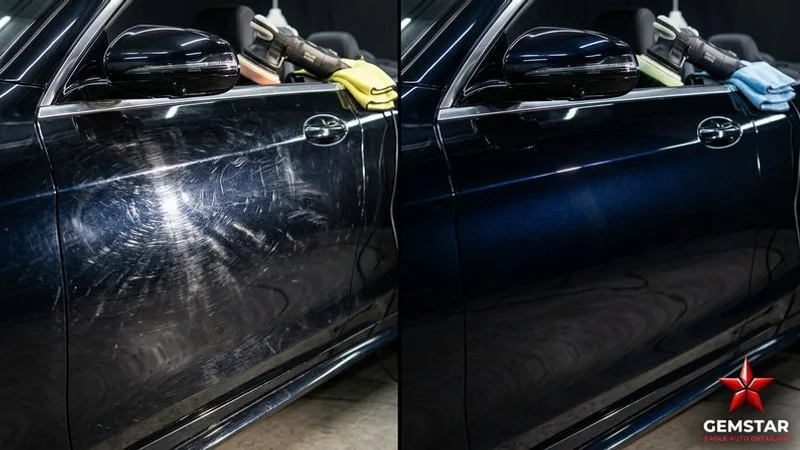
- Swirl marks: Circular scratches usually caused by automatic car washes.
- Light scratches: Minor abrasions from brush contact or improper hand washing.
- Water spot etching: Mineral deposits from hard water that have eaten into the clear coat.
- Oxidation: Dullness and fading caused by prolonged UV exposure.
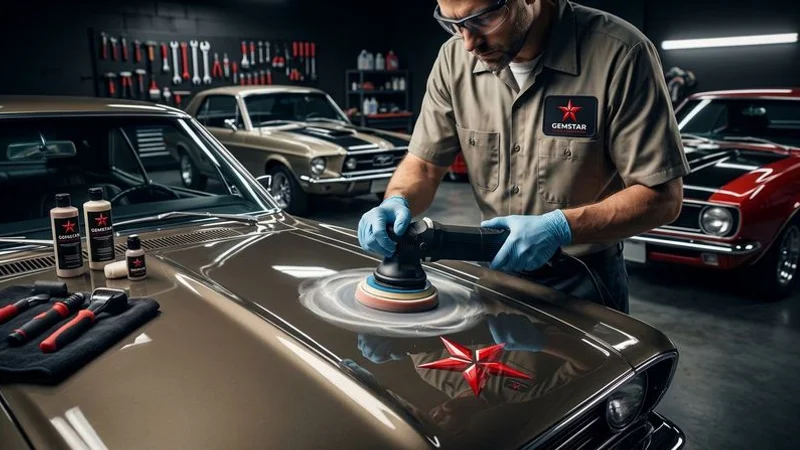
We utilize industry-standard tools like the RUPES LHR15 Mark III dual-action polisher to safely achieve these results. This precision equipment guarantees a smooth, defect-free surface that reflects light uniformly. When done correctly, paint correction transforms dull, marred paint into a mirror-like finish.
Do You Need Paint Correction Before Ceramic Coating? The Core Concept
Here is the critical concept that many vehicle owners miss about surface protection. Ceramic coating does not hide imperfections. It amplifies them.
A ceramic coating is essentially a transparent, ultra-hard shell that bonds to whatever surface is beneath it. Most professional coatings cure to a 9H hardness on the pencil scale and add an additional 1 to 3 microns of thickness over your clear coat.
“If your paint has swirl marks, those swirl marks will be locked under the 9H ceramic shell, remaining visible and permanent until the coating is mechanically removed.”
We often compare it to applying a clear laminate over a photograph. If the photograph has smudges or scratches, the laminate will not fix them. It will make them permanent.
This is precisely why every reputable installer insists on some level of paint correction before application. Our priority is to ensure the coating protects pristine paint rather than preserving damage.
How to Know If Your Vehicle Needs It
Nearly Every Daily Driver Does
If you have been driving your vehicle for more than a few months in Ada County, it almost certainly has some level of paint imperfection. Agricultural dust in the summer and magnesium chloride in the winter act like liquid sandpaper against your vehicle’s exterior. Automatic car washes with spinning brushes are particularly damaging and leave extensive swirl marks across every panel.
We see the results of this daily wear and tear constantly. A 2022 test by Auto Detailing Weekly compared 50 cars and found that 90 percent of vehicles washed with stiff bristle brushes developed visible swirl marks immediately. Even touchless washes use harsh acidic chemicals that can degrade your clear coat over time.
The Flashlight Test
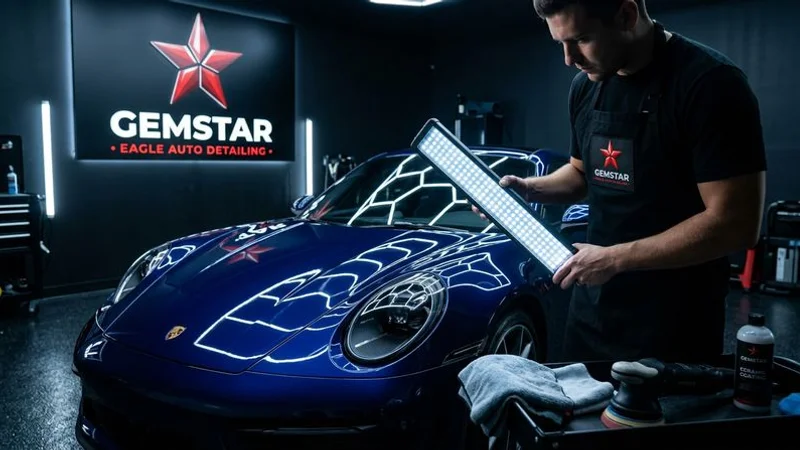
Take a bright flashlight or your phone’s flashlight and hold it close to your vehicle’s paint at various angles. Our detailing studio uses specialized Scangrip Multimatch 8 inspection lights that output up to 8,000 lumens to reveal true paint conditions. You can perform a basic version of this test at home in a dark garage.
Look closely for these specific defects under the light:
- Spider web patterns: These are swirl marks, and they are everywhere on most vehicles.
- Linear scratches: Caused by brushes, keys, or road debris.
- Haze or cloudiness: Often a sign of oxidation or chemical damage.
- Small pits or rough texture: Could be industrial fallout or rail dust embedded in the clear coat.
If you see any of these under the light, your paint needs correction before coating.
New Vehicles Are Not Exempt
Many people assume a brand-new car does not need paint correction. Unfortunately, that assumption is usually incorrect. New vehicles frequently arrive at the dealership with swirl marks from transport, dealer lot washing, and factory handling.
The detailing industry even has a specific term for this issue: the Dealer Installed Swirl Option (DISO). We have corrected paint on vehicles with fewer than 100 miles on the odometer because improper lot washing caused severe micro-marring. A quick inspection under an LED light will usually reveal these hidden factory and dealership blemishes.
Levels of Paint Correction
Not every vehicle needs the same level of correction. Our technicians evaluate the depth of the scratches and the total thickness of the clear coat before recommending a package. At Gemstar Eagle, we typically recommend one of three approaches.
To make the comparison clear, here is a breakdown of the typical correction levels:
| Correction Level | Defect Removal | Best Suited For | Typical Process |
|---|---|---|---|
| Single-Step Polish | 70% to 80% | New cars or vehicles with minor hazing | One pass with a finishing polish and soft pad |
| Two-Step Correction | 85% to 95% | Most daily drivers with moderate swirl marks | Cutting compound pass, followed by finishing polish |
| Multi-Step Correction | 95%+ | Neglected paint, heavy oxidation, deep etching | Multiple cutting stages, heavy compounding, final polish |
Single-Step Polish
This is the minimum level of correction we recommend before ceramic coating. It removes light swirl marks and haze, bringing the paint to around 70 to 80 percent defect removal. This approach is suitable for newer vehicles in relatively good condition.
Two-Step Correction
A two-step process uses a cutting compound followed by a finishing polish. This method achieves 85 to 95 percent defect removal and is appropriate for most daily drivers with moderate swirl marks and light scratches. We most commonly recommend this level for ceramic coating preparation.
Multi-Step Correction
For severely damaged paint with deep scratches, heavy oxidation, or extensive water spot etching, a multi-step correction is necessary. This process involves multiple cutting and polishing stages using heavy microfiber pads. It achieves the highest level of correction possible and is typically reserved for paint that has been neglected for years.
What Happens If You Skip Paint Correction?
We occasionally encounter clients who want to save money by skipping paint correction entirely. While the desire to reduce costs is understandable, ignoring the preparation phase has serious financial and aesthetic consequences. Applying a high-end coating over damaged paint traps the defects permanently.
Here are the specific consequences of skipping the correction process:
- Locked-in defects: Every swirl mark and scratch becomes permanent under the 9H hardened coating.
- Reduced gloss: The coating will not achieve its full optical clarity or mirror-like reflection on imperfect paint.
- Wasted investment: You are paying premium prices for a protective layer that will not look its best.
- Difficult removal: If you later want to correct the paint, the ceramic coating must be mechanically polished off first.
Removing a cured ceramic coating requires heavy compounding that strips away valuable clear coat thickness. This adds unnecessary cost and complexity to future detailing work. In short, skipping paint correction undermines the entire purpose of ceramic coating.
The Gemstar Eagle Approach
At our Eagle, Idaho facility, we never apply ceramic coating without at least a thorough decontamination and single-step polish. This standard ensures that your vehicle receives the best possible foundation. We inspect every vehicle under Scangrip high-intensity LED lights with adjustable color temperatures ranging from 2500K to 6500K to assess the paint condition accurately.
Our process ensures that when the ceramic coating goes on, it is bonding to the cleanest, smoothest, most optically perfect surface possible. This detailed preparation is how we deliver results that Treasure Valley clients love for years. Every step is designed to maximize the lifespan and gloss of your investment. For more on durability expectations, read our guide on how long ceramic coating lasts in Idaho’s climate.
So, Do You Need Paint Correction Before Ceramic Coating? The answer is a definitive yes if you want long-lasting, flawless results.
Ready to give your vehicle the complete treatment? Learn more about our paint correction services and ceramic coating packages, or call us at (208) 953-9102 to schedule your consultation. Our team is ready to help you protect your investment and keep it looking flawless.
Tags
Related Service
Learn More About Our Ceramic Coating Service → About Justin
Co-Founder & Lead Detailing Specialist at Gemstar Eagle Auto Detailing
Co-founder of Gemstar Eagle with 15+ years in professional auto detailing.
Related Articles
Ceramic Coating vs. Wax: Why Eagle Residents Are Switching
Discover why more Eagle, Idaho drivers are choosing ceramic coating over traditional wax. Compare durability, protection, cost, and long-term value for your vehicle.
How Long Does Ceramic Coating Last in Idaho's Climate?
Learn how long ceramic coating truly lasts in Idaho's extreme weather conditions and what factors affect its longevity on your vehicle.
How Much Does Ceramic Coating Cost in Eagle, Idaho?
Get a clear breakdown of ceramic coating costs in Eagle, Idaho. Understand what affects pricing and how to choose the right package for your vehicle.
Ready to Book Your Detail?
Put your knowledge into action. Schedule a premium mobile detail with Gemstar Eagle today.